Legacy Point: Enchanted Rock Expanding Gen-Set Production, Testing Capacity in Houston
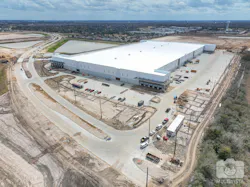
Houston-based microgrid project developer Enchanted Rock is moving and expanding its natural gas generator production in a new industrial site near Cypress, Texas.
Real estate logistics firm Prologis has completed the full-building lease with Enchanted Rock for the Legacy Point development. Enchanted Rock will use the 407,302-square-foot site to produce its next-generation line of onsite power systems to serve growing demand from rising data center, automation and mission-critical electrification capacity.
Prologis is developing the full Legacy Park site which will include facilities for multiple tenants.

“Our new facility strengthens our ability to scale production to meet growing demand while maintaining the quality control that supports reliable performance from our technologies,” said Paul Froutan, Chief Operating Officer at Enchanted Rock, in a statement. “The Legacy Point location enables us to manage supply chain risk and deliver the power flexibility and resilience our customers rely on—while balancing long-standing customer commitments with growing large-load demand.”
Many of those customers are seeking future off-grid solutions with so-called “speed to power” urgency considering cloud-based and artificial intelligence computing pressures and utility electric transmission bottlenecks.
The Legacy Point facility will be where Enchanted Rock produces its newest onsite power systems such as its ERT500 500-kW natural gas generator, as well as modular RockBlock units, Froutan noted. The RockBlocks will be capable of generating more than 1 GW of annual combined capacity in gen-sets ranging from 1.5 MW to 3.5 MW per unit.
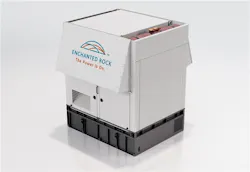
Enchanted Rock will operate the production and testing hub site around-the-clock. Prologis has started developing additional facilities within the park and hopes to have Legacy Point completed in 2 to 3 years.
These systems are engineered to create utility-scale power for bridge prime power, flexible capacity, resiliency services and grid support, the company says.
Enchanted Rock also is scaling up integrative systems, including EPC (engineering, procurement and construction), permitting, fuel strategy, operations and maintenance, energy market participation and 24/7 power project monitoring through its microgrid control center.
The electric utility sector was forecasting flat load growth less than a decade ago, and reports such as the quadrennial American Society of Civil Engineers Infrastructure Report Card is grading the macro grid at low levels of readiness for the Industrial Compute Age.
This is driving large digital infrastructure, commercial and industrial (C&I) sector companies to seek out alternative means of intersection power resource and sustainability goals. One of those objectives is a movement sometimes called “speed to power” which is accelerating off-grid, distributed energy projects that are quicker to build and can circumvent long utility interconnection delays.
Enchanted Rock CEO John Carrington pointed out how the rise of AI-enabled data centers and industrial automation has created a power resource gap which fast-moving companies are best positioned to fill.
“The real change in our industry is speed to power,” Carrington said in an exclusive interview with MGK sister website EnergyTech.com late last year. “Traditionally Enchanted Rock has been working with C&I, and what’s interesting in C&I now is that when it comes to 5 MW of load or more it’s very hard for the customers to be interconnected; that could take three, four or even six years,” said Carrington, who stepped in as executive chairman of the Enchanted Rock board earlier in 2025 and now is CEO.
“We come in and put the product in, and it becomes on-site prime power (for the customer),” he added. “Once it gets interconnected it can become backup power. Utilities want it because they can pull from it later. Customers want it because it’s getting them up and running.”
Enchanted Rock introduced the ERT500 and RockBlock technologies in September 2025. Once deployed in microgrid and on-site power projects, the generators will be fueled by underground natural gas supply and can replace diesel-fired generators.
Paralyzed by Digital Transformation? Start Here
New EnergyTech Webinar Featuring Siemens Digital Industries
Connecting Data, Engineering and Operations Across All Energy Sectors
Free and Live 2 pm ET Tuesday, March 10 at EnergyTech.com
On Demand for Many Months
About the Author

Rod Walton, Microgrid Knowledge Managing Editor
Managing Editor
For Microgrid Knowledge editorial inquiries, please contact Managing Editor Rod Walton at [email protected].
I’ve spent the last 18 years covering the energy industry as a newspaper and trade journalist. I was an energy writer and business editor at the Tulsa World before moving to business-to-business media at PennWell Publishing, which later became Clarion Events, where I covered the electric power industry. I joined Endeavor Business Media in November 2021 to help launch EnergyTech, one of the company’s newest media brands. I joined Microgrid Knowledge in July 2023.
I earned my Bachelors degree in journalism from the University of Oklahoma. My career stops include the Moore American, Bartlesville Examiner-Enterprise, Wagoner Tribune and Tulsa World, all in Oklahoma . I have been married to Laura for the past 36-plus years and we have four children and one adorable granddaughter. We want the energy transition to make their lives better in the future.
Microgrid Knowledge and EnergyTech are focused on the mission critical and large-scale energy users and their sustainability and resiliency goals. These include the commercial and industrial sectors, as well as the military, universities, data centers and microgrids. The C&I sectors together account for close to 30 percent of greenhouse gas emissions in the U.S.
Many large-scale energy users such as Fortune 500 companies, and mission-critical users such as military bases, universities, healthcare facilities, public safety and data centers, shifting their energy priorities to reach net-zero carbon goals within the coming decades. These include plans for renewable energy power purchase agreements, but also on-site resiliency projects such as microgrids, combined heat and power, rooftop solar, energy storage, digitalization and building efficiency upgrades.